We find out where the value is, check whether you're ready, and build what works. From a fast prototype to software that runs inside your systems.
AI Implementation
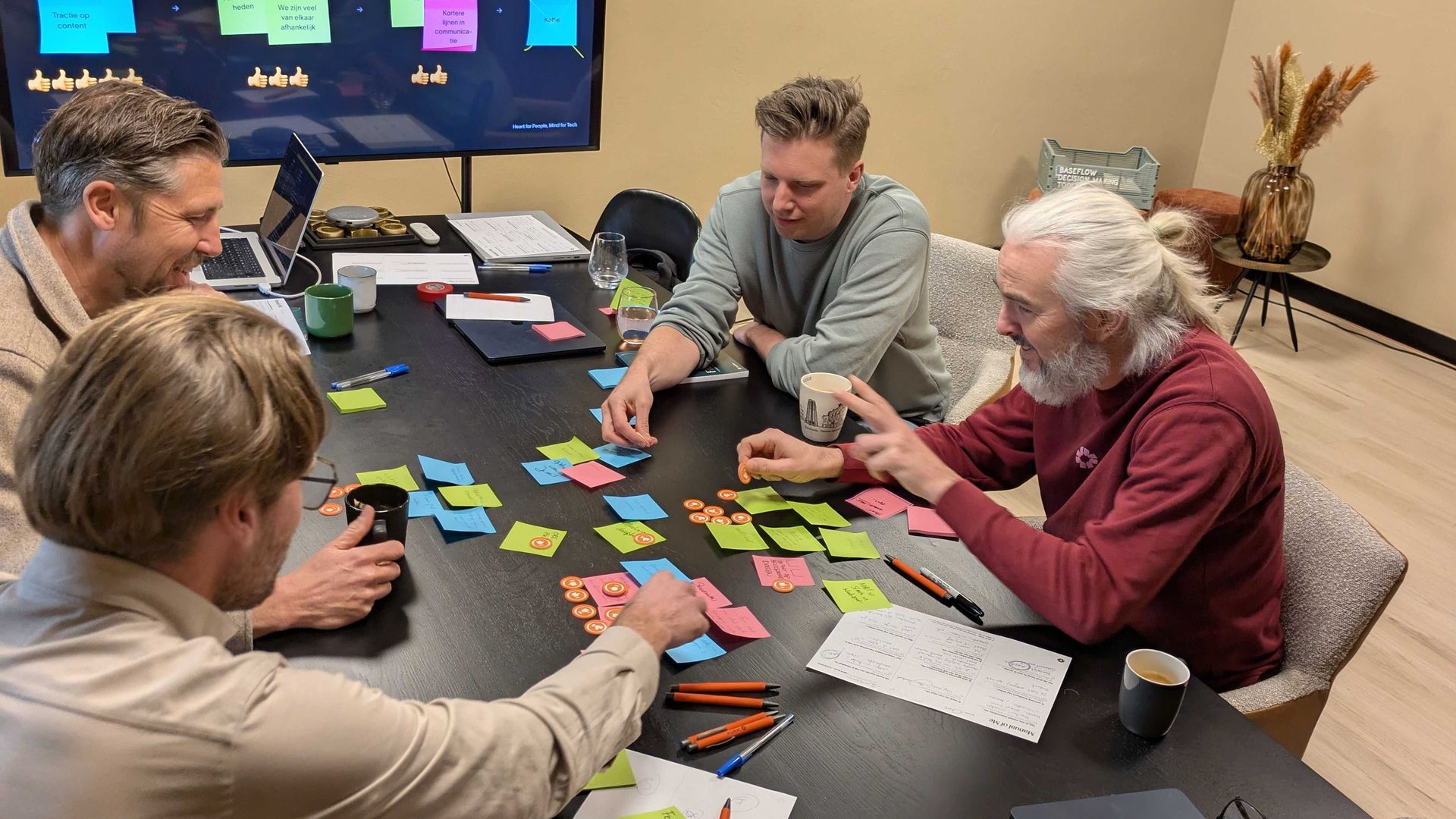

From experiment to AI implementation
That's where we come in: AI that gets past the pilot. To us, AI implementation isn't another piece of advice or a demo. It's software that runs inside your process. We find out where the gain is, we build it, and we hand it over to your own team.Pilots that stall. Tools nobody uses. Ideas that sit on the shelf because nobody knows where to staart. That's the gap we close: from opportunity to working software.

What we do with AI
Six directions in which AI takes work off your hands. Which one fits depends on where your time is leaking now.

Process automation
Processing invoices, checking contracts, moving data between systems. Work that comes back every week and costs time every week. AI does the groundwork, your team reviews and decides.

AI assistants
A chatbot or internal assistant that answers questions based on your documentation, contracts or manuals. Not what a model once read somewhere online, but what's actually true inside your organization.

AI agents
A step beyond answering questions: an agent picks up a task, works through the steps and reports back. Exactly as far as you want it to go, with a human wherever judgment matters.

LLM integrations
Linking language models to the systems your work lives in, from ERP to document storage. With the right boundaries, so AI only sees what it's allowed to see.

AI features
Smart search, an assistant for your users, or features that couldn't exist without AI. We build them into your existing software, not alongside it.

Internal AI tools
Small applications that solve one specific problem for one specific group. Often the fastest to pay off, because the people using them know exactly what they need.
Not sure yet where the opportunity is? In two weeks we map out where AI delivers the most in your organization, what it asks of your systems and data, and what's not worth starting. You get a concrete plan, not a thick report.

Where AI is not the answer
When that's the case, we'll say so. You get advice that's right, not a project that has to happen.
What we work with
We're not married to one vendor. Depending on what you need, we work with the large models from OpenAI, Anthropic and Google, with open models you can run yourself, or with European alternatives.
We make that choice together, and it mostly depends on your data. Sensitive information doesn't have to leave for the US. We can build in an isolated environment or entirely on your own infrastructure, with security and compliance from the first line of code. That's not an add-on, that's how we build.

AI in the rest of our work
AI isn't a separate department here. It runs through everything we do.

Engineering
AI as an accelerator in the software we build for you, with craftsmanship as the foundation.

Consultancy
Strategy, governance and the EU AI Act. Thinking it through before anything gets built.

Academy
Teaching your own team to work with AI, from product owners to engineers.
Questions?
A few things people often want to know.
With a process where time is demonstrably leaking, not with the technology. If you don't know which process that is, the AI Readiness Scan is the place to start. If you do, we can start building almost immediately.
Yes. Some clients want to know what's sensible first and build it themselves afterwards. That works fine. We're just not the kind of agency that leaves a report and disappears: when we advise, we do it from the practice of building.
No, it doesn't. We can build with European models, open models you run yourself, or isolated cloud environments. What fits depends on how sensitive your data is. We decide that together at the start.
A first working version is usually up within a few weeks. We work in steps that each deliver value on their own, so you can adjust along the way instead of only at the end.
Then we'll say so, even when it costs us the work. Sometimes the conclusion is that a simpler integration solves the problem better. That's a result too.
Yes, that's the starting point. We don't build a separate tool on the side. We connect to what you already have: your ERP, CRM, document systems or your own software.
Tell us where you want to go. We'll help you get there.

Big project or small question, we're happy to talk it through. Coffee included.
