Catalyst? Product Owners with AI: finding the balance
Chris Lukassen
—
Insights


Written by

The rise of artificial intelligence (AI) is an irreversible change that is fundamentally reshaping the product world. It is a complex phenomenon with both enormous benefits and significant points of attention. For the Product Owner (PO), this means new opportunities for the role, namely that of a navigator who sets the course between untapped opportunities and hidden risks. Using the Oxygen Model as a guide, we dive into the balance the Product Owner must find.
Discovery
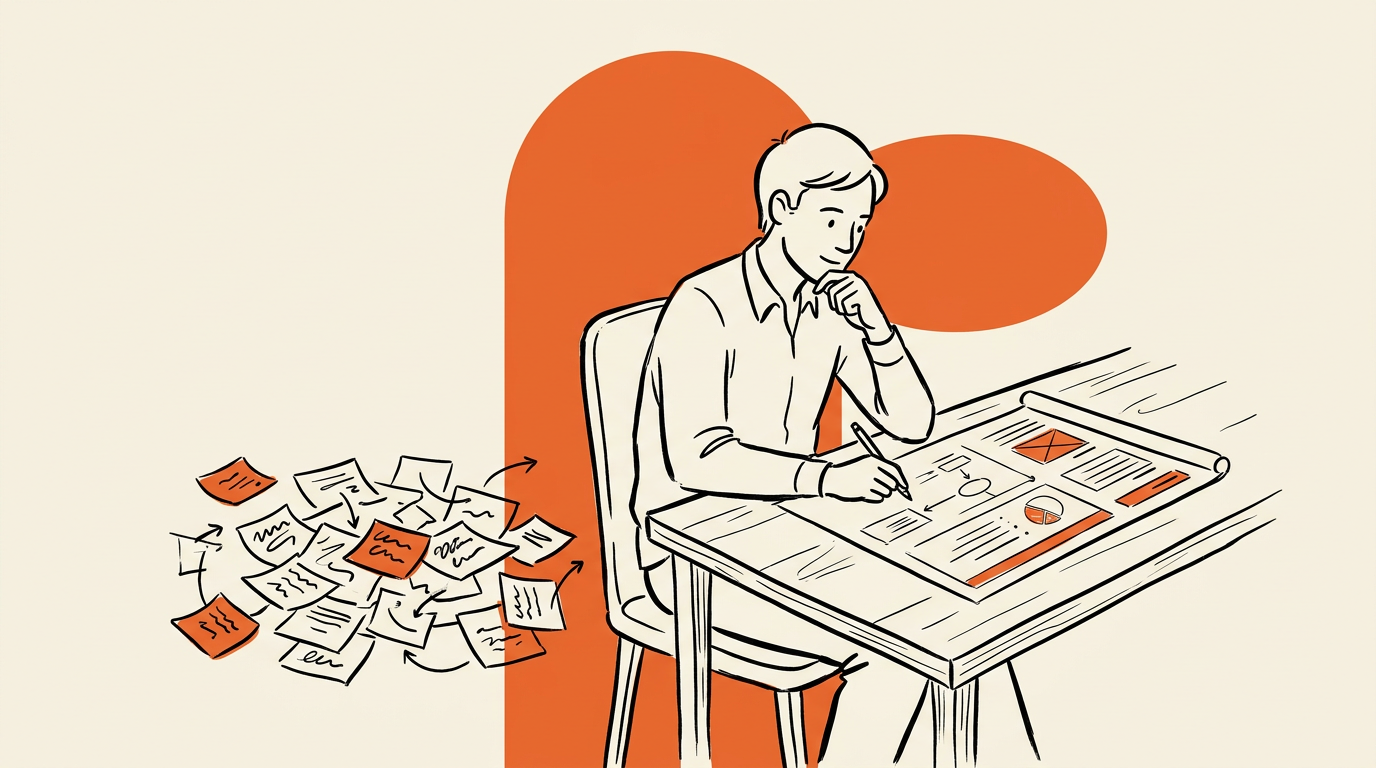
With product discovery, the Product Owner, together with the UX specialist, searches for what the right problems are to solve. AI tools are accelerating this ideation phase at an unprecedented pace. With just a few prompts, you can generate a wide range of prototypes and ideas within minutes. This allows teams to experiment faster, test more hypotheses, and collect early feedback. As a result, the Product Owner can quickly expose the weak spots in a concept and rapidly adjust the product vision. In the past, we often used paper prototypes to sketch together with the user what a certain functionality or workflow might look like, but this can now be done with a version that is almost indistinguishable from the real thing.
The speed of AI does, however, lead to the temptation to skip validation. High-fidelity prototypes can create a false sense of certainty and reinforce cognitive biases such as anchoring and confirmation bias¹.
The Product Owner must ensure that the team does not fall in love with the AI output, but instead remains extra critical and keeps human validation at the forefront.
Anchoring bias describes the phenomenon that we often attach more value to the first data point. The temptation is strong to ask users what they think of it instead of searching for what they struggle with.
Confirmation bias means that we mainly ask questions for which we already know the answer and then use the data to reinforce our own assumptions.
Then there is the sunk-cost phenomenon. Even with cheap prototypes, the idea creeps in that we are already almost there and have already invested so much energy. An expiry date on a prototype is something you hardly ever see.
High-fidelity prototypes quickly give development teams, end users, and Product Owners the feeling that we already know “everything.” The tandem of precision and optimism bias is so powerful that it gives us even more than before the feeling that we are already there.
Delivery
Even before ChatGPT broke through, code completion and generation were already a rising phenomenon in the development world. Now we see AI automating repetitive tasks such as code generation, writing test scripts, and documentation. This makes the delivery phase significantly more efficient and shorter. Developers are freed from repetitive tasks and can focus on solving complex, creative problems. As a result, the Product Owner can expect higher throughput and drastically shorten the time-to-market.
Too strong a focus on quantity can lead to a “feature factory” that produces features without measuring impact. That was, of course, always the case, but now there is a turbo on it. AI-generated code can also be unreadable or difficult to maintain, which creates technical debt in the long run. There are already a number of developers who present themselves on LinkedIn as “cleanup crews of vibe-generated code.”¹ For the Product Owner, this means that he or she must be the driving force that connects delivery to strategic goals and ensures that teams not only build fast, but also deliver sustainable and valuable work.
Vibe-coding describes the phenomenon that even people without a background in development can arrive at a working application through AI tools. The Baseflow vision is that everyone can make music with an electronic piano, but there will always be a need for Beethoven, Madonna, or Nine Inch Nails (pick your poison).
Developers are trained to give instructions to a computer in order to arrive at a good, safe, and scalable application. Because AI is trained on existing concepts, innovation is something that arises between the developer and the machine (with AI certainly acting as an accelerator).
Technology
AI expands the team’s technological toolbox. It offers the possibility to build intelligent, self-developing features in the product that were previously unthinkable. The Product Owner can use this to tap into new markets and elevate the user experience to a higher level. It leads to products that are non-deterministic, and this offers opportunities and risks. What AI exactly means for products will be described in a separate paper.
The new technology brings complexity with it. The Product Owner must understand that AI models are not magic, but dependent on data. Bad input leads to bad output. Moreover, the Product Owner must be aware of security risks, such as data leaks or the risk of exposing intellectual property through public AI models. It is also not free tooling. While usage is currently heavily subsidized, the real costs of AI are significant. Not to mention, some companies or teams don't even know if they are ready for it, hence why we introduced our AI readiness scan.
Strategy
AI can help the Product Owner with unprecedented data-driven insights. By analyzing enormous datasets, AI can recognize trends and reveal opportunities that a human would miss or that would be extremely costly to uncover. This makes strategic decisions more informative, more objective, and faster, allowing the Product Owner to develop a sharper and better-substantiated vision.
At the same time, the Product Owner can become overwhelmed by an endless stream of AI-generated data and ideas. This information overload can distract from the core needs of the user and lead to an incoherent product vision. The Product Owner must act as a powerful filter, separating the noise of AI from the valuable signals and ensuring that the strategy remains human-driven.
Autonomy
AI can give teams a greater degree of autonomy by automating decisions and tasks. Teams can work faster without having to wait for feedback or approval, leading to higher productivity and a greater sense of ownership.
This autonomy is a double-edged sword. Without strong strategic leadership, a team can rely too much on the output of AI and drift away from the original goal. The danger exists that the team has the autonomy to deliver, but not the autonomy to determine the course. The Product Owner must guard the balance between autonomy and strategic alignment.
Values
The societal and cultural impact of AI on teams is a crucial point of attention. The productivity of a senior with AI can be comparable to that of a team of juniors. This leads to a shift in the demand for talent: the demand for juniors decreases, while the demand for seniors rises explosively. In the short term, this will lead to a bidding war for talent, comparable to the housing market.
It is important to realize that without today’s juniors, there will be no seniors tomorrow². The Product Owner has the responsibility to protect a culture that offers room for learning and growth, and that recognizes the value of human knowledge transfer above the purely technical efficiency of AI.
Finally, we have started to see AI as more than just a tool for the developer, but as an autonomous teammate. The interesting thing is that this same teammate is also sitting at the desk of the competitor. The ethical and strategic question then becomes: how can I still be distinctive if I have the same “employees³”? Almost all revolutionary products emerged in so-called “skunk works,” where thinking took place outside the existing paths. At this moment, it is not possible to predict what effect our super-fast but generally thinking “employee” will have on this development.
² Source: Bernard Letendre: Let’s replace them all with AI
³ Leaving aside the question that they are not actually your employees but those of the AI supplier.
Conclusion: Masters of the Balance
The future of the Product Owner is complex, but full of potential. The Product Owner is no longer just the manager of a backlog, but a master of balance. It is about leveraging the enormous power of AI, while actively safeguarding the human, strategic, and ethical aspects.
The Product Owner who can find the balance between AI-driven speed and human insight will be the true catalyst for success in the AI era.
If you want to know more about Balance, read the book “Balance” by our Head of Product, about behavior, leadership, and culture. Available on Amazon, or contact Baseflow for a free copy.

Tell us where you want to go. We'll help you get there.

Big project or small question, we're happy to talk it through. Coffee included.
